The evolution of dirt on modern farming has come a long way, from a farmer using a horse to pull a plow through their fields to artificial intelligence-powered machines doing that same task today. Agricultural development is one of the most powerful mechanisms to end extreme poverty, boost shared prosperity, and feed 10 billion people by 2050. To maintain and provide for our growing populations, we must modernize, optimize, and streamline our current agricultural practices. Many factors have led to technology changing the face of farming. Still, the modernization of farming is an inevitable future to tackle the ever-changing challenges faced within the industry.
In less than 30 years, the world population is expected to grow by 2 billion, which means converting to sustainable food production is essential for our future. Currently, our global food production system is unsustainable and will not accommodate the expected growth of our global population. Smallholder farmers are often overlooked as a solution to increase food production globally significantly, yet, if given the correct tools, they may be the key we need to succeed.
Typically, smallholder farmers use 80 percent of their yield to feed their families and are left with 20 percent to sell and make a profit. If these farmers have ways to increase their yields and sell more than just 20 percent, it would benefit their families and significantly impact the global food supply. Some technologies can drive the necessary change in agriculture, from IoT sensors and satellites to drones, and Blockchain. However, these technologies are often expensive and complicated to use, which deters smallholder farmers from using them. Therefore, there is a need to make these innovative technologies accessible to farmers to increase their yields and transform their farming practices.
Despite how far our farming methods have come, currently, we are struggling to keep up with our global needs. Today, Blockchain, artificial intelligence (AI), machine learning (ML), satellite data, remote sensing, mobile access, drones, and Internet of Things (IoT) sensors, are all becoming more and more common in everyday farming. This technology helps farmers reach our global needs in more efficient ways through improving yields, reducing overall cost, and mitigating potential risks.
Blockchain technology is an immutable record or transaction that can optimize and track assets. For example, Blockchain in agriculture can collect seed quality information, monitor crop growth, track and store vet records, or track yields from farm to store. It also streamlines financial and insurance-based needs. In addition, track and trace is used for document flow, making it easier to export to international markets and seeing where bottlenecks are in their supply chain process, and making decisions in real-time with real-time reporting.
Satellite data is a highly cost-effective tool in agriculture. It surveys and assesses agricultural land and provides invaluable insights for farmers and even governments. For example, satellite data can measure; how fertile a farmer’s soil is, predict weather patterns, monitor livestock rotation, and geofencing. Furthermore, satellite data is coupled with other relevant data to achieve more accurate and diverse information that farmers can use to understand their land better and improve farm management practices. Remote sensing analyzes satellite data and data from other sources like soil sample analysis, IoT sensors, drones, weather stations. And farmer surveys to estimate conditions like soil fertility and predict weather patterns.
Mobile technology in agriculture is an excellent tool because it is an efficient and cost-effective way to share. And exchange valuable data and knowledge widely and increase communication for farmers. Some shareable examples of information are market prices, reports on best management practices for pests, or forecasted weather conditions.
Drones and IoT sensors survey and analyze the soil in the field, and generate real-time data. Which helps farmers improve their soil and crop management while simultaneously increasing their yields. Drones can significantly reduce labor costs because they can accurately assess and transmit anything impacting farm productivity. Additionally, IoT sensors can mount onto drones for additional agriculture monitoring.
Artificial intelligence (AI) performs predictive analytics and allows farmers to collect and process more data. For example, AI can improve the accuracy of planting, harvesting dates, recognizing diseases, pests, or poor nutrients in crops, detecting any weeds growing in fields, and which herbicide to apply.
Climate change has a significant impact on the livelihood of smallholder farmers. And is one of the leading causes why these farmers need AgTech solutions. For example, farmers constantly adapt to temperature and weather changes that no longer support their crops. Technology can mitigate those risks by predicting weather patterns. And providing farmers with actionable data to make smarter and more sustainable decisions.
Technology is being adopted by more and more people every day. And the more farmers gain access to technology, the faster we are moving to modernized and sustainable farming practices. Dimitra aims to deliver agriculture technology to 100 million farmers worldwide over the next five years. And make a concrete and tangible difference in the global food supply chain. The Dimitra platform provides advanced technologies to farmers. And these technologies provide actionable recommendations which can positively impact the outputs on their farms.
Dimitra is a solution that may help break the cycles of poverty and food insecurity and enrich farmers’ local economies. Through these increases in their crop yields if applied across villages, communities, and regions. Dimitra is conscious of the uncertain future we face. We’re committed to meeting these challenges head-on with a mission to make a difference. By increasing farming productivity, implementing more sustainable farming practices, and improving soil quality globally.

New Horizon Building, 3-1/2 Miles Philip S.W. Goldson Highway, Belize City
info@dimitra.io
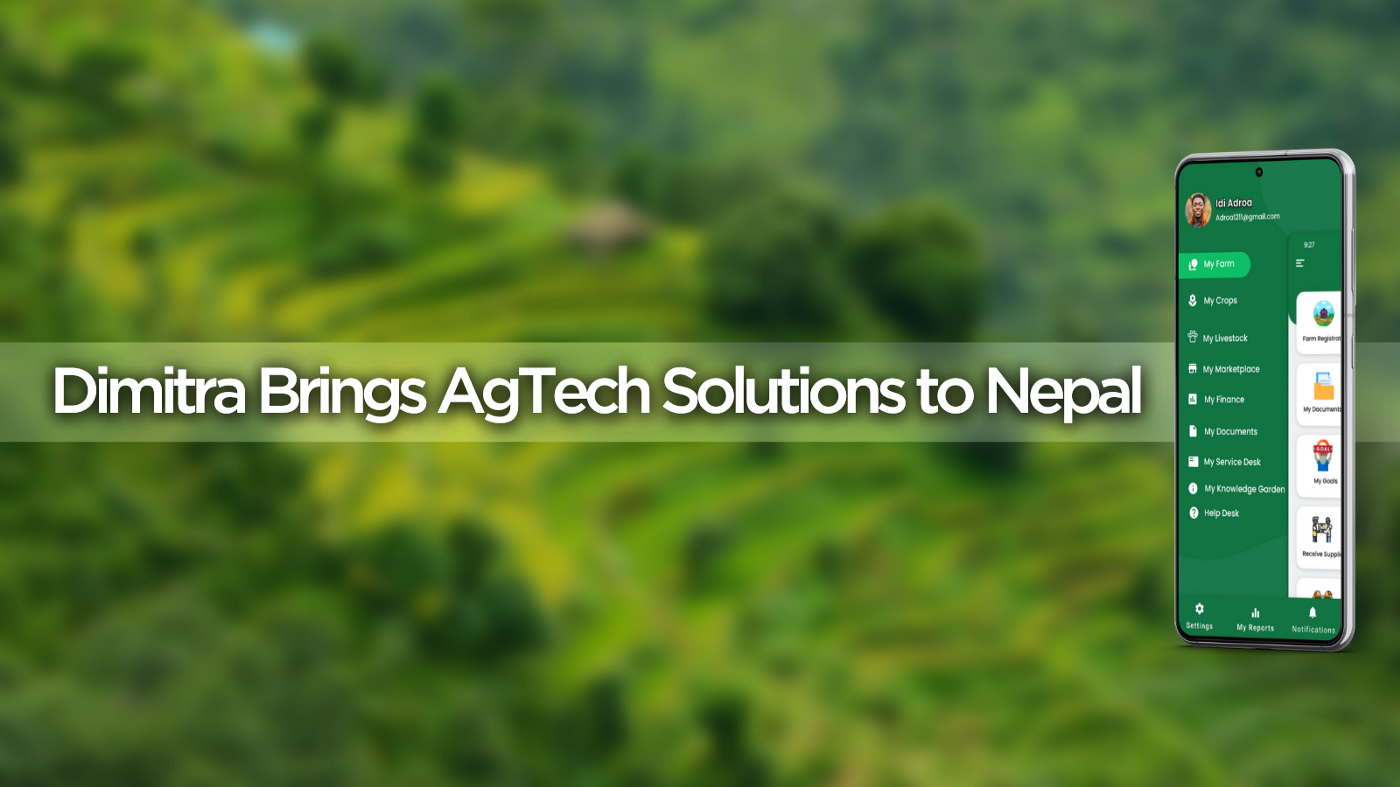

Nepal relies heavily on subsistence farming techniques and more than 60% of its population is engaged in farming related activities. Food insecurity continues to be a major issue for Nepalese communities and food imports into Nepal have increased six-fold over the last decade. Nepalese smallholder farmers, like many other nations. Are also struggling to navigate increasingly erratic rainfall patterns, climatic change and other barriers to achieving year-round crop success. All of these things combined have greatly impacted Nepalese farmers profitability and their bottom line on agricultural exports.
Dimitra Incorporated has partnered with three leading Nepalese agricultural organizations; Nepal Multipurpose Cooperative Society Ltd. (NMC), Jeevan Bikas Samaj (JBS) and Nepal Krishi Care Pvt Ltd. Dimitra is providing advanced agricultural technology solutions and will introduce regenerative crop and livestock methods to Nepalese smallholder farms. Dimitra’s goal is to enhance Nepalese farmers’ productivity, increase Nepalese farmers household incomes, and introduce sustainable farming methods.
Jeevan Bikas Samaj (JBS) is a national-level NGO in Nepal established to improve marginalized people’s socio-economic and cultural circumstances.
Nepal Krishi Care Pvt Ltd (NKC) provides solutions for the value supply chain problem in the cereal sectors of agriculture within Nepal.
The Nepal Multipurpose Cooperative Society Ltd. (NMC) aims to raise members’ economic and living standards through access to agricultural technology to foster self-reliance and mutual support.
By providing ongoing training and technology coupled with cutting-edge applications, Dimitra aims to help local farmers create a more effective seed to sale process in agricultural areas of cereals, vegetables and seed production, as well as streamlining processes in livestock and fishing sectors. The following Dimitra modules will be used in Nepal; My Farm, My Crop and My Livestock. In conjunction with sensor management, as well as satellite and weather modules.
Fair and equal access to Agtech solutions will help local farmers monitor fields, improve soil conditions, increase water outputs, reduce disease. And has the potential to help Nepalese farmers respond quickly to environmental threats and provide effective solutions. Dimitra anticipates that by using machine learning data combined with algorithms. It will help Nepalese smallholder farmers increase output yields each and every year. Working in collaboration with NMC, JBS and NKC. Dimitra will provide a holistic implementation plan and will monitor the ongoing progress.
Here’s what Dimitra CEO and founder, Jon Trask, had to say about this exciting new partnership:
“I anticipate a long and fruitful partnership with the JBS, NKC, and NMC in Nepal and look forward to working with all the Nepalese farmers. We expect we will learn a lot from each other along the way in this exciting new journey. And my sincere hope is that we can bring new agricultural concepts and solutions to Nepal. And that we can also bring our knowledge from other countries we are working with to Nepal and this will help Nepalese farmers. I am also excited to learn more about Nepalese Tea and Cardamom and other crops in Nepal, and about Nepal’s unique agricultural methods and markets.”
High-value crops with profitable export potential in Nepal include large cardamom and orthodox tea. However, Smallholder farmers in Nepal work in difficult mountainous terrains, including areas where access to irrigation and unpredictable climate can lead to low yields. And technologies to track the progress from seed to sale. And this has had the effect of lower output yields and operational waste.
Tea production is not only integral to Nepalese culture, it’s a valuable crop that contributes greatly to the local and national economy. Typically grown in the foothills of Nepal, tea production involves meticulous farming methods dating back hundreds of years. More than 80% of orthodox tea produced in Nepal is exported to Europe and North America, but local farmers lack direct access to international markets. As a result, they are forced to rely on middlemen who move stock through India which drastically reduces profitability and Nepalese smallholder farmers remain vulnerable to external power dynamics.
Large cardamom, makes up roughly 5% of current exports from Nepal, and this is also mainly sent through India for export. As with orthodox tea, export potential is marred by Nepal’s landlocked geography, limited access to India’s transport infrastructure, strict food safety regulations, and complex customs clearing procedures. A smallholder farmer who is producing large cardamom in a remote location in Nepal may overcome all growth and harvesting obstacles, only to face setbacks when the time comes to sell their product. Coupled with poor market facilities, a lack of auction platforms and inadequate warehouse storage facilities. Means that one of Nepal’s most valuable exports rarely makes it directly to world markets. And the end result is that Nepalese farmers suffer.
Streamlining export processes with blockchain technology can assist farmers in many ways. For example, blockchain technology can be used to digitize and automate shipping processes and compliance documentation. “Track and Trace” solutions provide real-time data, creating digital footprints for Nepalese farmers, international consumers, and also helps governments keep track of yields from seed to sale. Traceability also fosters trust, communication, and transparency between players. Which also greatly reduces expenses and ensures accountability and minimizes potential pain points along the value supply chain.
Another example of where blockchain technology can help would be securing and navigating funding. This process is often complicated by long commutes to facilities like banks in metropolitan city centres from remote locations. Blockchain lending solutions facilitate direct access to funding, education, and trade right to farmers’ doorsteps. Built-in scalability in digital formats creates long-term sustainable solutions for real-world problems smallholder farmers face every day.
Dimitra aims to provide smallholder farmers in Nepal easy access to blockchain technology, IoT sensors and actionable insights. Based on machine learning that will create a highly effective and sustainable supply chain management platform from start to finish. By incorporating digital technologies with agricultural practices, this has the potential to transform Nepalese Tea and Cardamom outputs. By automating sales and marketing processes with these new digital technologies. It will help connect Nepalese farmers directly to otherwise unreachable markets.
Dimitra’s partnership with NMC, JBS and NKC will help smallholder farmers in Nepal secure a more productive and sustainable future. Nepal’s farming communities can also be a transformative force within Nepal. This has the potential to increase Nepal’s GDP while also helping feed vulnerable populations in the face of climate change.
New Horizon Building, 3-1/2 Miles Philip S.W. Goldson Highway, Belize City
info@dimitra.io

Agricultural CeDeFi: Dimitra Incorporated ($DMTR) is entering the agricultural lending and insurance market. Making micro loans available to 570 million small holder farmers around the world through Dimitra’s proprietary agricultural management platform.
According to the World Bank. The food industry is the largest sector of the global economy, comprising 10% of the world’s economic output. To date, only a few Crypto and DeFi applications provide services into the agricultural lending, insurance, and management space. Dimitra is driving change in this space, first with its Dimitra Connected Farmer app, second with its Livestock and Genetics Management, and now with Dimitra’s newly released SaaS model.
comments, “utilizing a CeDeFi strategy to provide capital and insurance to operations in the agricultural industry provides farmers access to new avenues of funding. And also enables Ag-based centralized financial institutions to make an entry into the crypto market and share the risk and rewards by combining exciting new crypto concepts and solutions that accelerate the world’s largest economic sector and also provide new opportunities globally. We are very excited to partner with leading DeFi lending and insurance companies and provide these solutions to the people who need them most.”
Dimitra currently has teams on the ground in 68 countries and can provide these CeDeFi lending and insurance solutions to hundreds of millions of farms. The Dimitra Platform offers innovative risk management capabilities through satellite, drone, IoT sensor, farmer observation (photographs and measurements), and analysis. Dimitra also monitors farm performance and provides real time data driven recommendations to farmers. With the goal of increasing yields, reducing costs, and mitigating risks. Satellite analysis of previous years’ crop performance is available going back 20 years which can aid in assessing loan risks.
Dimitra’s SaaS platform has been created and developed through an discovery process with governments and NGOs across the world. This collaborative approach coupled with testing has led Dimitra to secure contracts with farm associations globally.
By using Dimitra CeDeFi mechanisms, farms and lending companys will explore innovative and modern financial lending and borrowing solutions while meeting regulatory, compliant, and conventional financial standards.
Farming (i.e., Crop and Livestock)
Supply Chain Management, and
Trade Finance
These types of loans will allow small holder farmers to collateralize their crops by securing a loan with crop certificates.
These loans will be under pinned by the Dimitra Token ($DMTR). Also, $DMTR token staking provides financial yield opportunities to participants in the rapidly growing world of decentralized public crypto economics.
Dimitra’s My Finance module, which is part of the Connected Farmer Platform. Automates the loan management process and speeds up the process for farmers to get loans who need them the most. In early 2022, Dimitra will announce partnerships with several crypto companies that will supplement these financing processes. Conceptually, farms will secure micro loans with crop certificates or purchase CeDeFi funded insurance policies to offset risk.
New Horizon Building, 3-1/2 Miles Philip S.W. Goldson Highway, Belize City
info@dimitra.io
Dimitra Incorporated is honored to sign agreements to deliver Agricultural Technology, Digital Technology & Regenerative Farming Methods in Crop and Livestock with three distinguished organizations within Nepalese agriculture: The NMC (Nepal Multipurpose Cooperative Society Ltd.), the JBS (Jiwan Bikash Samaj), and Nepal Krishi Care (NKC) Pvt Ltd. These Nepalese organizations consist of hundreds of thousands of households to whom Dimitra will provide new and innovative technology solutions for Nepal’s agriculture sectors. The goal is to ensure effective delivery to market and improve profitability for the following Nepalese crops; dairy, cereals, fish, fruits, vegetables, seed production; from farmers to end consumers with a framework of sustainable livelihood development in Nepal.
aims to serve its members and continuously improve member health, member education, and improving environmental footprint. The NMC plans to raise members’ economic and living standards by giving members more agricultural knowledge via technology. To help with self-reliance, mutual support, a sense of frugality, and encourage the good habit of saving.
“We are trying our best to figure out how to do better for smallholder farmers. I am happy with this participant program, I don’t know how we can improve, and I think I can learn from you all on where we can improve knowingly, thank you.” — Mr. Ram Chandra Uprety, Chairman, Nepal Multipurpose Cooperative Society Ltd., Mechinagar Municipality, Jhapa, Nepal.
is a national-level NGO in Nepal established to improve marginalized people’s socio-economic and cultural circumstances. The JBS mission is to enhance the quality of life of poor people by increasing their access to resources. The JBS provides solutions for Nepal’s supply chain and the Nepalese agricultural sectors.
“ I think this is a big opportunity for us. This is the first step and I hope all these things give us a lot of knowledge and information and technologies I think especially in MIS systems and software systems. I think we can increase our bigger benefit to the local community, especially farmers. Thank you.”- Mr. Yogendra Mandal, Executive Director, Jiwan Bikash Samaj, Morang, Nepal.
provides solutions for the value supply chain problem in the cereal sectors of agriculture. The NKC is a social enterprise that supports technologies and practices, including the internet of things (IoT). The NKC provides consulting services in different stages of the agricultural value chain.
“We feel privileged to be associated with this kind of function and having this agreement with the world-renowned Dimitra, thank you to the Dimitra team. We are really hopeful that we can use the long experience and wide experience of Dimitra in the agriculture sector in Nepal in general, and for Nepal Krishi Care in specific.”-Dr. Ramchandra Khanal, Director, Nepal Krishi Care, Belbari, Nepal.
Dimitra Incorporated is a global technology company that provides an ecosystem of agricultural technology products to advance smallholder farming performance. Through mobile technology, IoT sensors, artificial intelligence, blockchain, satellite imagery, and drones.
“I think with NMC, NKC, and JBS we will have long and fruitful partnerships and we’ll learn a lot from each other, we can bring some of our technology, we can bring all our knowledge from other countries, I am sure we will learn a lot about Nepal markets, about Nepal methods and all of the successes of Nepal Agriculture. Each country we go to, we learn a lot about that country and we learn more about ourselves.” — Jon Trask, CEO & Founder, Dimitra Incorporated
Dimitra is committing to these leading Nepalese organizations and will help enhance productivity and double Nepalese farmers’ income by adopting digital technologies and regenerative farming methods in crop and livestock management. And Dimitra will use a combination of Blockchain, IoT sensors, and more to provide a cutting-edge supply chain management platform that will also maximize and automate sales and marketing processes and digitize their supply chain. They will provide technology, training, applications, and share knowledge with farmers. Which will strengthen Nepalese institutions and enhance farmers’ productivity and profitability.
My farm, my crop, my livestock, sensor management, satellite and weather modules are creating awareness and lead to more sustainable farming practices in Nepal. Dimitra will work collaboratively with JBS, NKC, and NMC. And create an implementation plan and will monitor the results during the engagement with specific objectives that are of interest to all partners. Dimitra is looking forward to all the great opportunities that this agreement will bring.
“I am very glad to be a part of this agreement ceremony between these three organizations who are linking to 400,000 farmers of the province and Dimitra. It’s a great day actually. I would like to congratulate all of you and there is, I hope that one objective, doubling the income of farmers of that area will be definitely increased with the use of this technology and the government of Nepal will be always with you. Another thing that I would like to share with you is how this technology can be transferred to the other provinces and the demand for the technology should be created among the farmers of the other province. Now, we are in a digital world and we are linking with this program in the digital world and we always struggled with new technology. Clearly Province One is the first to accept the new technology and take leaps for using this one and with the small one. Now we have three organizations who are really working with the farmers for their wealth and everything. I hope that the objective of this agreement will be fulfilled and the government of Nepal will definitely like to join with Dimitra and in the future within our rules and regulations. This is really great and I hope that with our hard work, this will continue in the whole country and will definitely increase the numbers of farmers in Nepal and that Jon will always support Nepal by interlinking farmers with the digital world. Lastly, I would like to congratulate once again to all of you, thank you.” — Mrs. Niru Dahal Pandey, Secretary, Ministry of Agriculture and Livestock Development, Kathmandu, Nepal.
One of Nepal’s primary export commodities actively contributing to the local and national economy is the Highland orthodox tea. Sought after in international markets because of its quality, aroma, taste, and aftertaste.
Nepalese tea farmers pick tea with their recipe and then roll the leaves by hand before oxidizing them. Consequently, the Nepalese tea farmers fail to receive higher international market prices. Which tempts them to increase their yields by using chemical fertilizers and pesticides to make up for lost profits.
Large cardamom is the number one commodity produced in Nepal, and its exports have doubled this year. The spice has a strong, camphor-like flavor, with a smoky character obtained from these drying methods.
When the pandemic arrived, so did an increase in demand for large cardamon. However, Nepali cash crop entrepreneurs have faced many challenges trying to keep up with the demand due to the high cost of production. Iinadequate storage facilities, tariff and transportation constraints, and the lack of knowledge from actual production to export markets.
The Highland orthodox tea and large cardamom are just two examples of how Dimitra, NMC, JBS, and NKC will work together to make a difference in Nepal using digital technology and regenerative farming practices in crops and livestock.
New Horizon Building, 3-1/2 Miles Philip S.W. Goldson Highway, Belize City
info@dimitra.io